
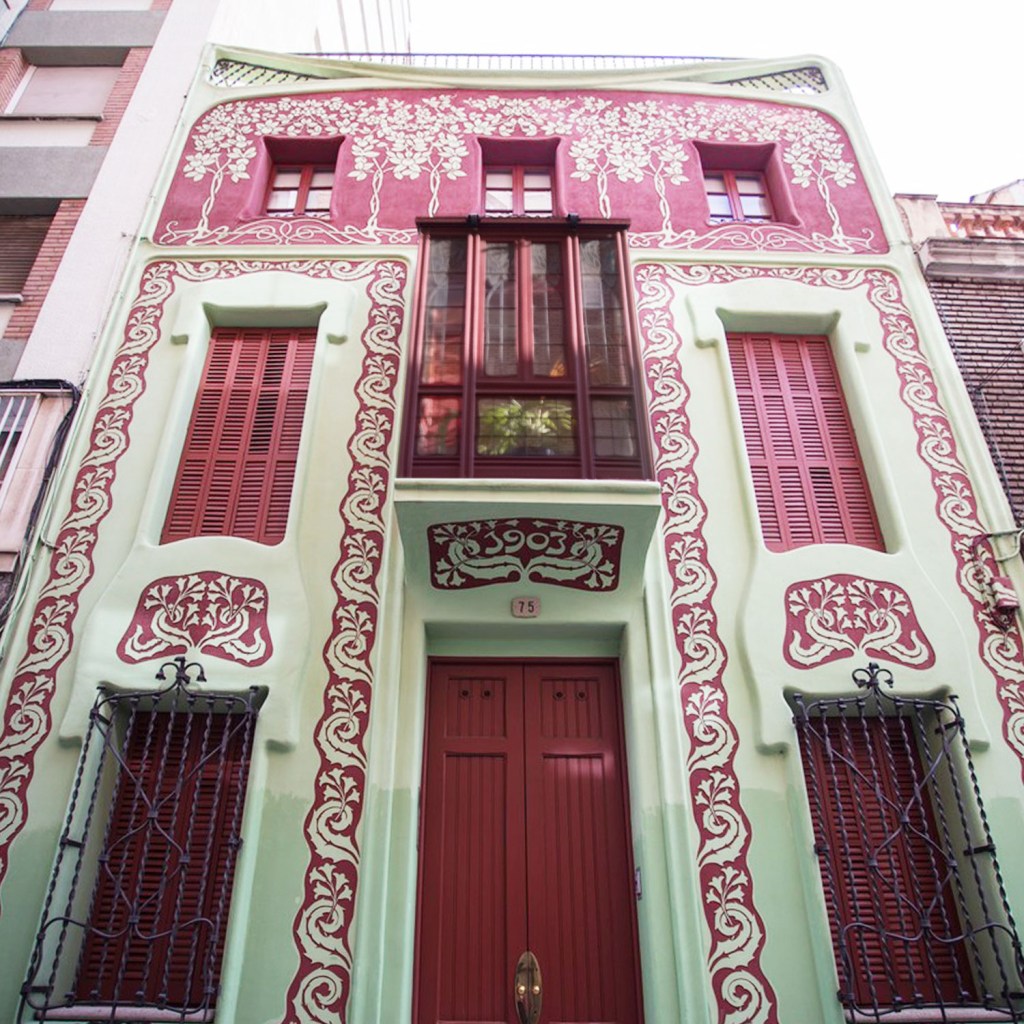
Covered in lively red and pale green sgraffito, this facade evokes a romantic-like garden, with winding flowering vine plants. Above the entrance, an elegant wooden gallery stands out, with stained glass windows, also depicting colourful geraniums.
The architect
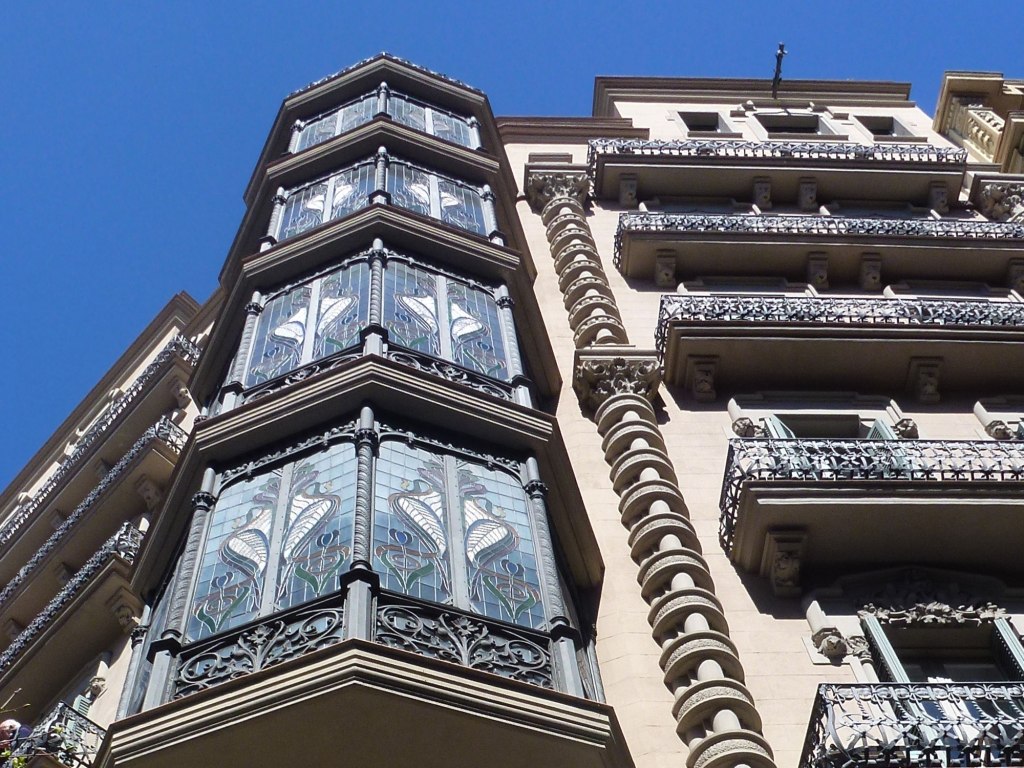
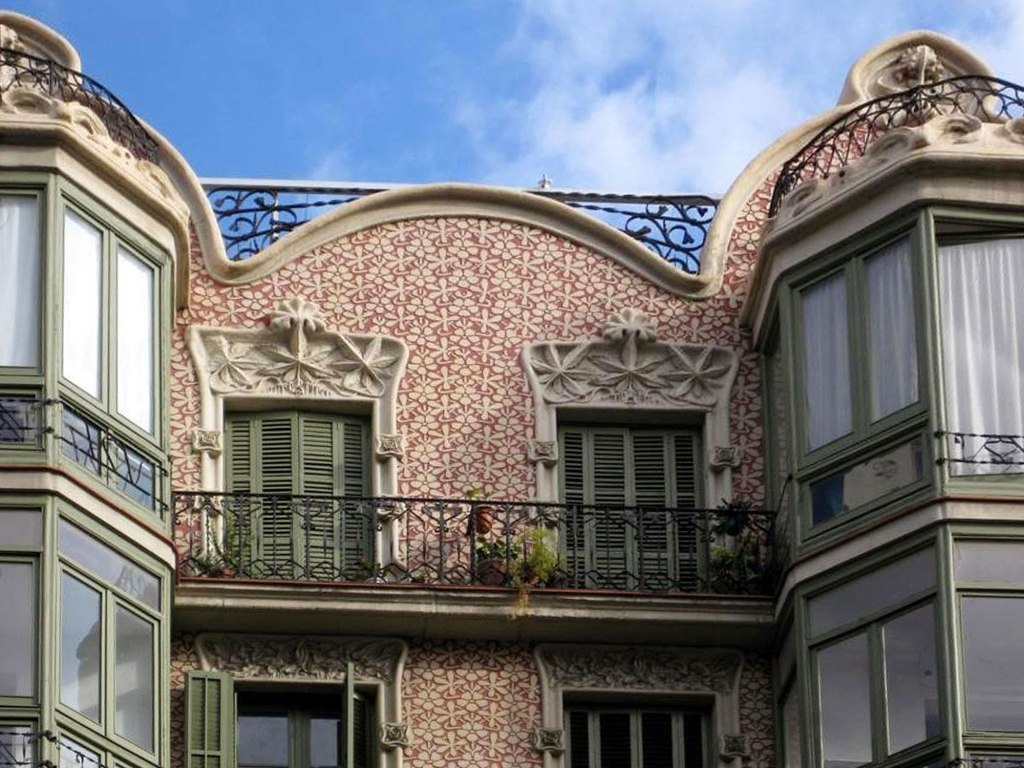
The Enric Ribalta house was designed by Catalan modernist architect Jeroni F. Granell i Manresa (1867-1931). I didn’t know much about his work before having seen this house, but I found out that, actually, several of my favourite houses here in Barcelonaare his design! If you’ve been to Palau de la Música Catalana or the Sant Pau Modernist Site then you’ve also seen his work, as he is the one who designed the spectacular stained-glass ceilings, together with Antoni Rigalt. Granell’s other works are concentrated mostly on apartment buildings that can be found mainly in Eixample, like the two ones below – on 82 València, and 54 Balmes street.
Casa Enric Ribalta: a brief history

Designed for Enric Ribalta and Mercè Camellas, the construction was completed in 1903. Until the mid-1970’s, local press says this house was the headquarters of the Esencias Buil SA, a perfume laboratory. The owner of the company, Josep Buil, could not have chosen a location more in line with the product of his small business, a Modernist residence, whose rich floral decoration on the facade seems to even give off delicate countryside aromas.

After years of abandonment, the building was restored and remodelled in 1989 by ABAA Arquitects (Lluís Alonso i Calleja and Sergi Balaguer i Barbadillo), keeping only the original facade and rethinking the entire interior). Three years later, the project won the Rehabitec award for the best rehabilitation.
I mentioned sgraffito, in the beginning. It’s a technique of decorating the walls by applying layers of contrasting colours, and then scratching or cutting the final layer to reveal the shade below. Sgraffito was popularized in Italy in the 15th and 16th centuries and is also specific to parts of Germany, Transylvania, Austria, Belgium or Catalunya – where it became recurrent during the Modernist era.
See this house at: 75 Pàdua street, El Putxet i el Farró
 Rutes de Barcelona
One thought on “A dream-like garden design on Pàdua street”